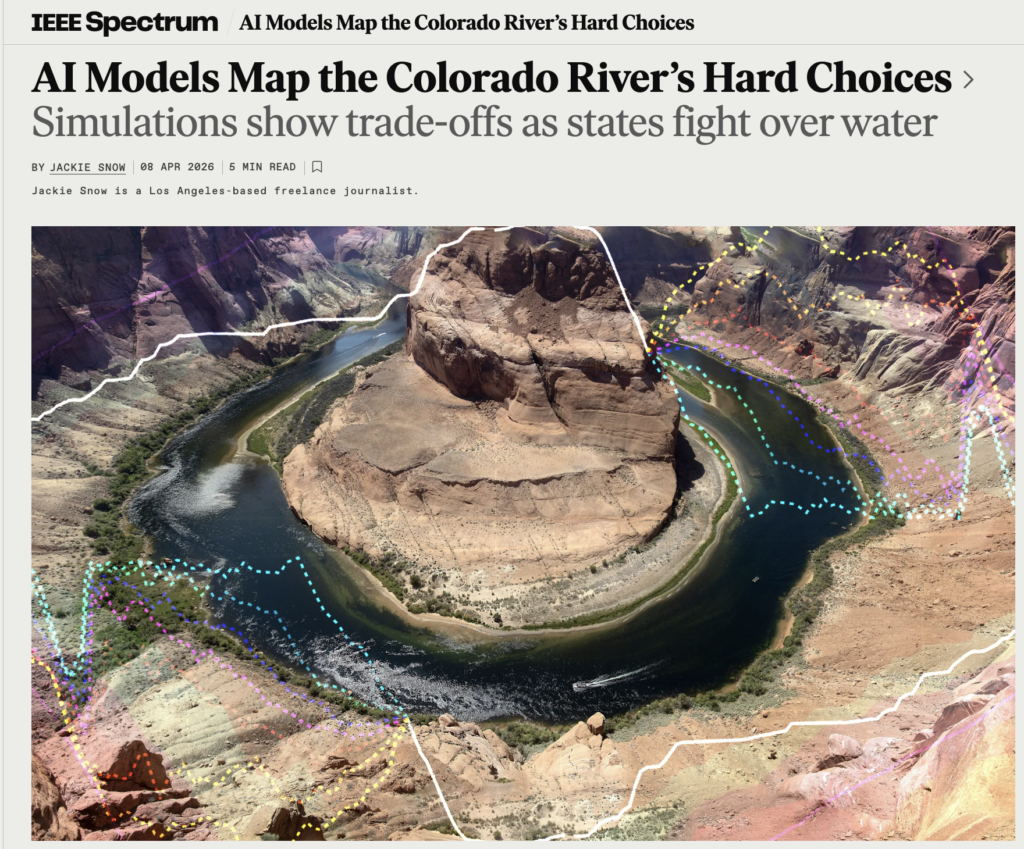
My new IEEE Spectrum piece on machine learning and the Colorado River is out. It’s my first byline there and I’m pretty delighted about it.
The river is having its worst year on record. Negotiations between the seven states over how to share what’s left have collapsed twice. And in the middle of all of that there’s this genuinely impressive ecosystem of tools being built to model what comes next — reservoir optimization algorithms running millions of simulations, graph neural networks mapping how conditions at one point in the river ripple downstream weeks later, hybrid deep learning models issuing drought warnings months out.
The piece doesn’t get into something that comes up constantly when you put AI and the Colorado River in the same sentence: data centers. It’s basically the first thing people mention. Data centers use a lot of water for cooling. AI is driving data center growth. The Colorado River is drying up. The story writes itself.
Except the numbers don’t really support it. In 2023, all U.S. data centers combined used roughly 50,000 acre-feet of water. The Colorado River’s total allocation is around 16 to 17 million acre-feet annually. That’s about 0.3 percent. Tribal water rights alone account for around 3 million acre-feet. Agriculture takes 70 percent of everything.
The data center story isn’t wrong exactly. But at the basin scale it’s a distraction from the harder conversation — the one about a 1922 legal framework (another topic I didn’t have room to really dive into!) that allocated more water than the river has ever reliably produced, and the human decisions that are going to have to be made about who gives up what. That story doesn’t have a villain as satisfying as a data center. But it’s the actual story.